
From labels to kilowatt-hours
De Duurzame Oplossing computes from four principles: the energetic behaviour of the home, the location it stands in, the behaviour of the residents and the factor of time throughout the whole year.
The home as a physical system
The philosophy behind De Duurzame Oplossing is fundamentally physical. When the desired indoor temperature differs from the outdoor temperature, heat loss occurs through walls, roof, windows, doors and floor. Heating compensates for that loss.
In summer the inverse holds: a heat surplus emerges, which cooling reduces. The insulation quality of the envelope determines comfort and the energy required for it. That energy need is expressed in kilowatt-hours, and what it costs is expressed in euros.

Residential focus
De Duurzame Oplossing focuses specifically on homes. That's where our expertise sits, and that's where most policy questions come from.
Residential behaviour has its own complexity. One resident showers in the morning, another in the evening. Everyone cooks at a different time. Washers and dishwashers run when convenient, not when the grid has headroom. Peaks vary by household, by season, by family composition.
For grid operators trying to prevent congestion, and for parties working with dynamic tariffs, that time dimension is exactly the point.
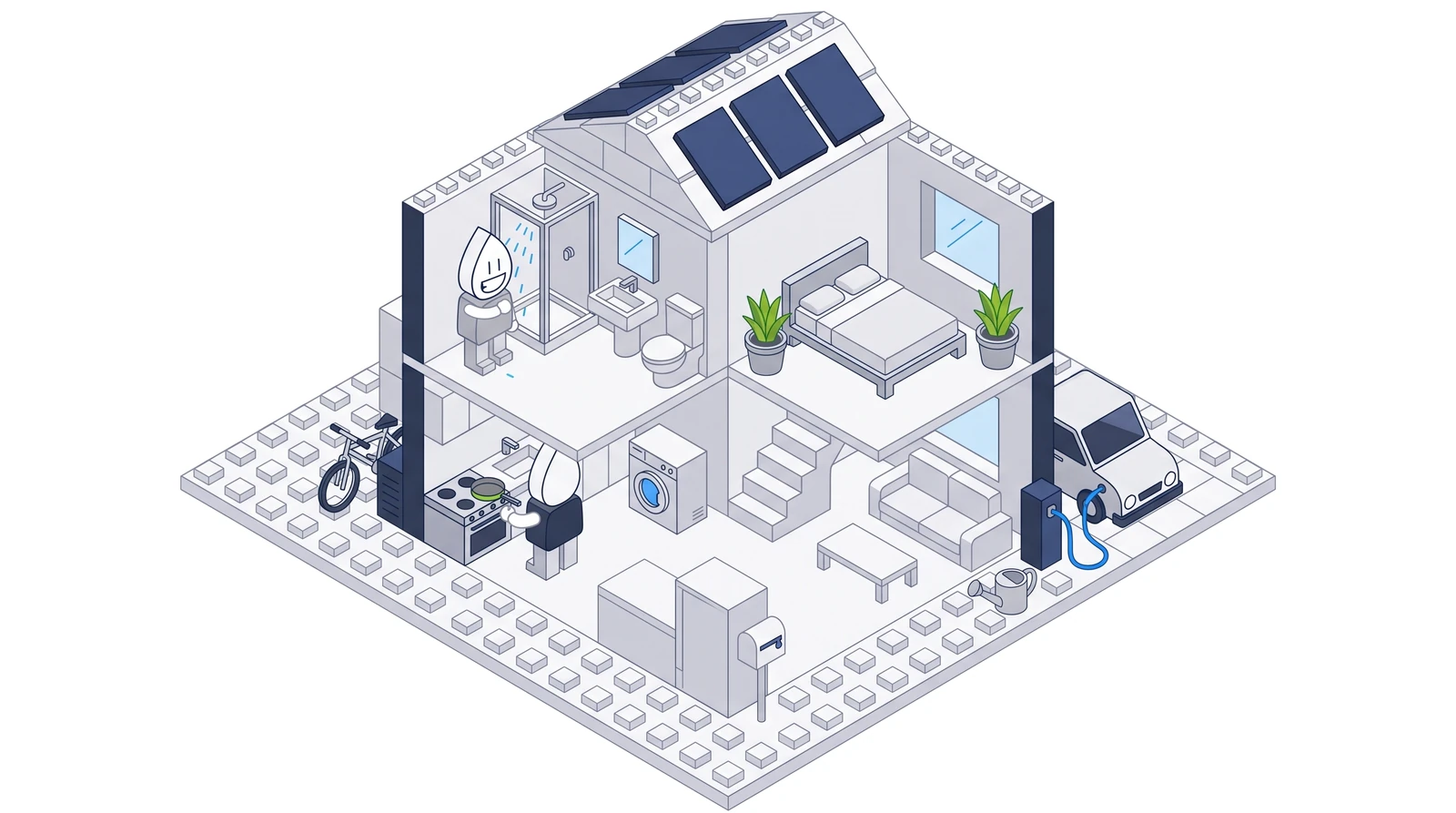
The factor of time
Our methodology and tools compute all 8,760 hours of a year for every individual home, from season level down to month, week, day, hour and minute. That makes peaks visible in supply and demand, simultaneity at the street level, and the effect of measures at specific moments.
Time works in three directions:
- How it was. What did an earlier measure actually achieve?
- How it is now. What is the current situation, hour by hour?
- How it could be. What does the next step yield, for this specific home?
That delta, the difference between now and later, spread across 8,760 hours, gives insight per home, per neighbourhood or per municipality.

Complementary to NTA 8800
NTA 8800 is anchored in Dutch building law and forms the basis for the energy label, BENG, EPV and a growing number of subsidy frameworks. Without a uniform methodology there is no comparability, no testable lower bound, no objective basis for subsidies or mortgage conditions.
Our methodology complements NTA 8800. NTA 8800 was designed for compliance and comparability; De Duurzame Oplossing for design questions and scenarios. Which measure works at this location, when does the peak fall, which combination yields the lowest real cost?
We use NTA 8800 to underwrite the business case where the law requires it, and dynamic modelling to determine which measure has the greatest effect on peak load, comfort and real energy demand.
What do these insights mean for your organisation?
A neighbourhood plan, a portfolio model or a modelling question. Find out how De Duurzame Oplossing helps you underpin your choices.
Get in touch