
A value that gets little attention
Anyone comparing triple glazing looks mainly at the Ug-value. It indicates how much heat leaks through the glass, per square metre and per degree of temperature difference between inside and outside, expressed in W/(m²·K). The lower the Ug-value, the better the glass insulates.
The same product sheet also states the g-value. In practice it often gets less attention, even though it is at least as interesting. The g-value indicates how much solar heat gets in. In winter, a free contribution to heating the home. In summer, a source of overheating.
Suppose you are comparing pane A and pane B, both triple glazing. Pane A has a Ug-value of 0.59 W/(m²·K), pane B of 0.53. On paper they insulate almost equally well. But the g-value of pane A is 0.6 and that of pane B 0.18. In winter pane A therefore brings in more than three times as much solar heat as pane B.
What is the g-value?
The g-value, also called the solar factor or total solar energy transmittance, indicates the share of the sunlight striking a window that ends up indoors as heat. The value is always between 0 and 1. With pane A, at a g-value of 0.6, 60% of the solar energy on the glass enters as heat. Part of it passes straight through the glass and gives off heat to floors and walls. Another part warms the panes themselves, and they pass part of that heat on to the inside.
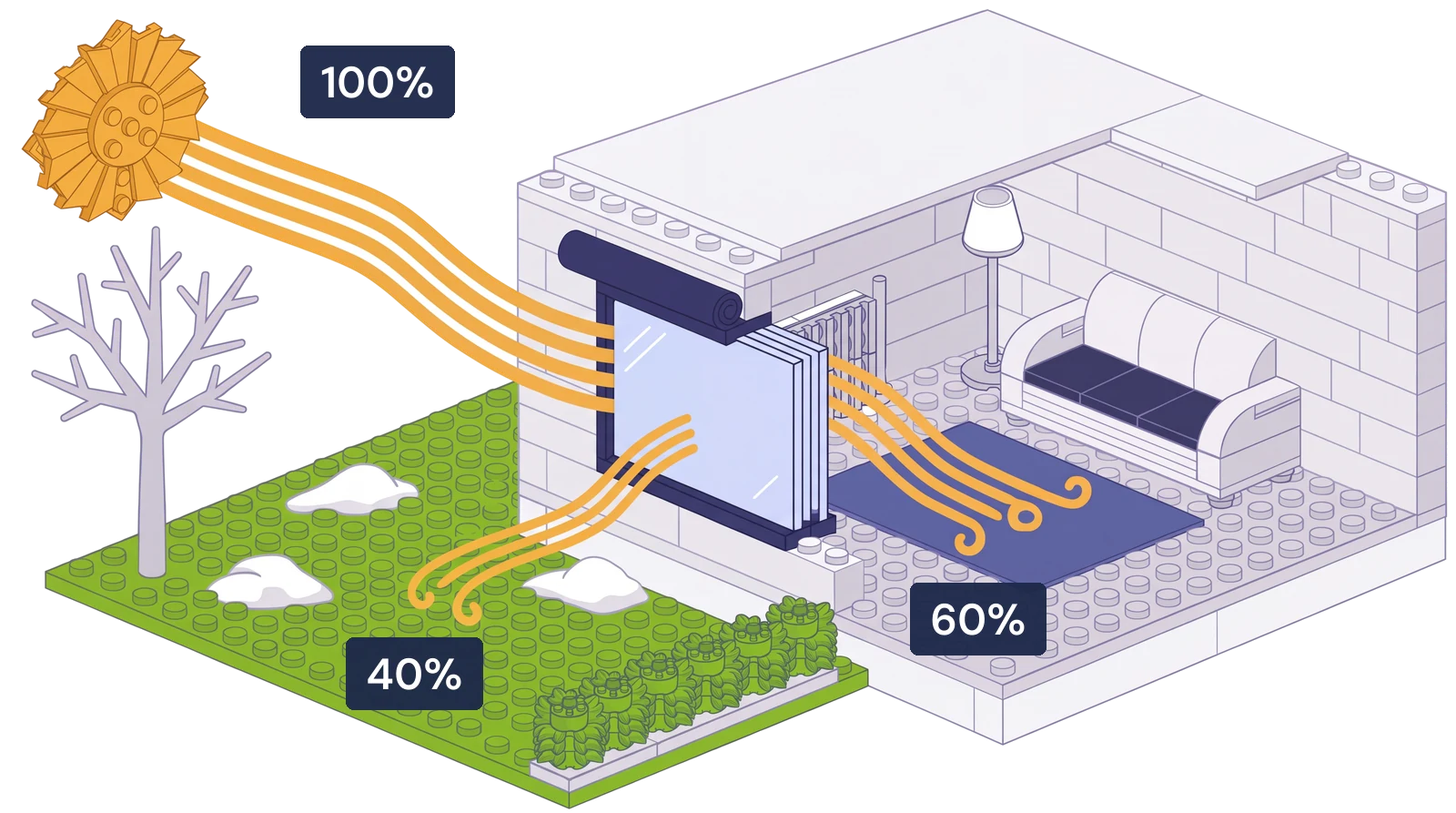
The g-value is about energy, not just visible light. Invisible infrared radiation counts too. The value applies to the complete glazing unit, including all panes, cavities, gas fills and coatings. Manufacturers determine the g-value to EN 410, at normal incidence of solar radiation. In reality the sun almost always strikes at an angle, so less sunlight and energy get in.
What does a coating do to the g-value?
A low-emissivity coating is a wafer-thin layer containing metal on the cavity side of a pane. It reflects the thermal radiation between the panes, so far less heat leaks through the glass. Without a coating, triple glazing lets through most of the solar heat, but it also loses far more heat.
The same layer also reflects part of the invisible infrared in sunlight. How much depends on the type of coating. Pane A has a coating that lets through plenty of solar heat. Pane B has a solar-control coating. As a result, only 18% of the solar energy on pane B enters as heat, in winter too.
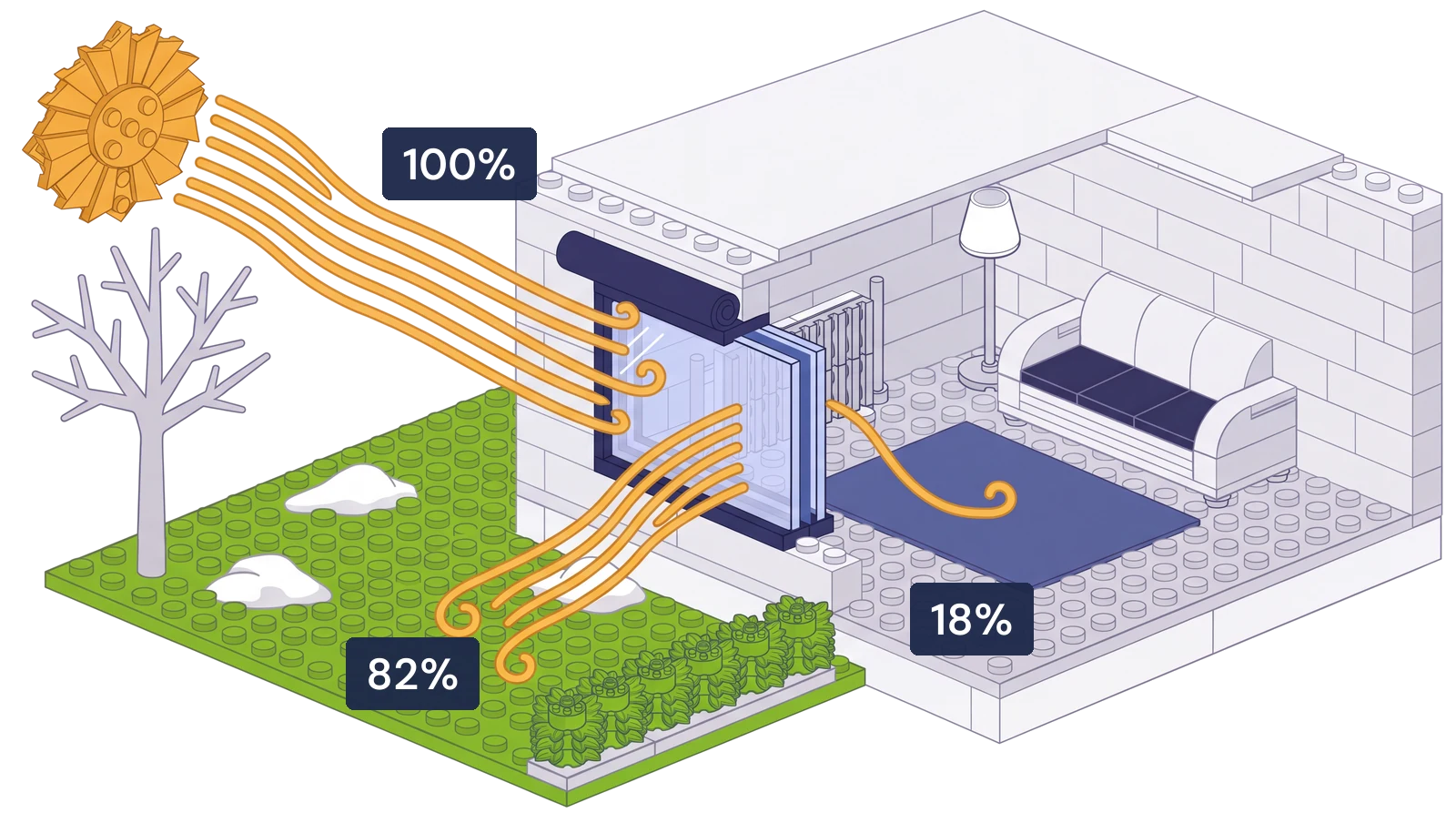
The winter balance of a window
Whether a window gains or loses heat over the winter can be checked with a rule of thumb by Wolfgang Feist of the Passivhaus Institut: Ug − 1.6 × g < 0. The factor 1.6 converts the g-value into solar gain over the heating season. The rule of thumb assumes a south façade in Central Europe with little shading. If the result is below zero, the glass brings in more solar heat than it loses. We call this energy-gaining glazing. For pane A the result is negative, for pane B positive: pane A gains heat over the winter, pane B loses it.
Three panes compared with the winter balance
The result of Ug − 1.6 × g for three panes. Below zero, the glass gains heat over the winter.
Choosing glazing and shading façade by façade
A high g-value brings heat in winter, but calls for shading in summer. An external awning catches the sun before it reaches the glass, so the heat stays outside. In winter you roll the awning in and the low winter sun simply comes in. Internal shading works less well: the heat the blinds or slats absorb is already indoors. A solar-control coating, as on pane B, works all year round and also keeps out the winter sun.
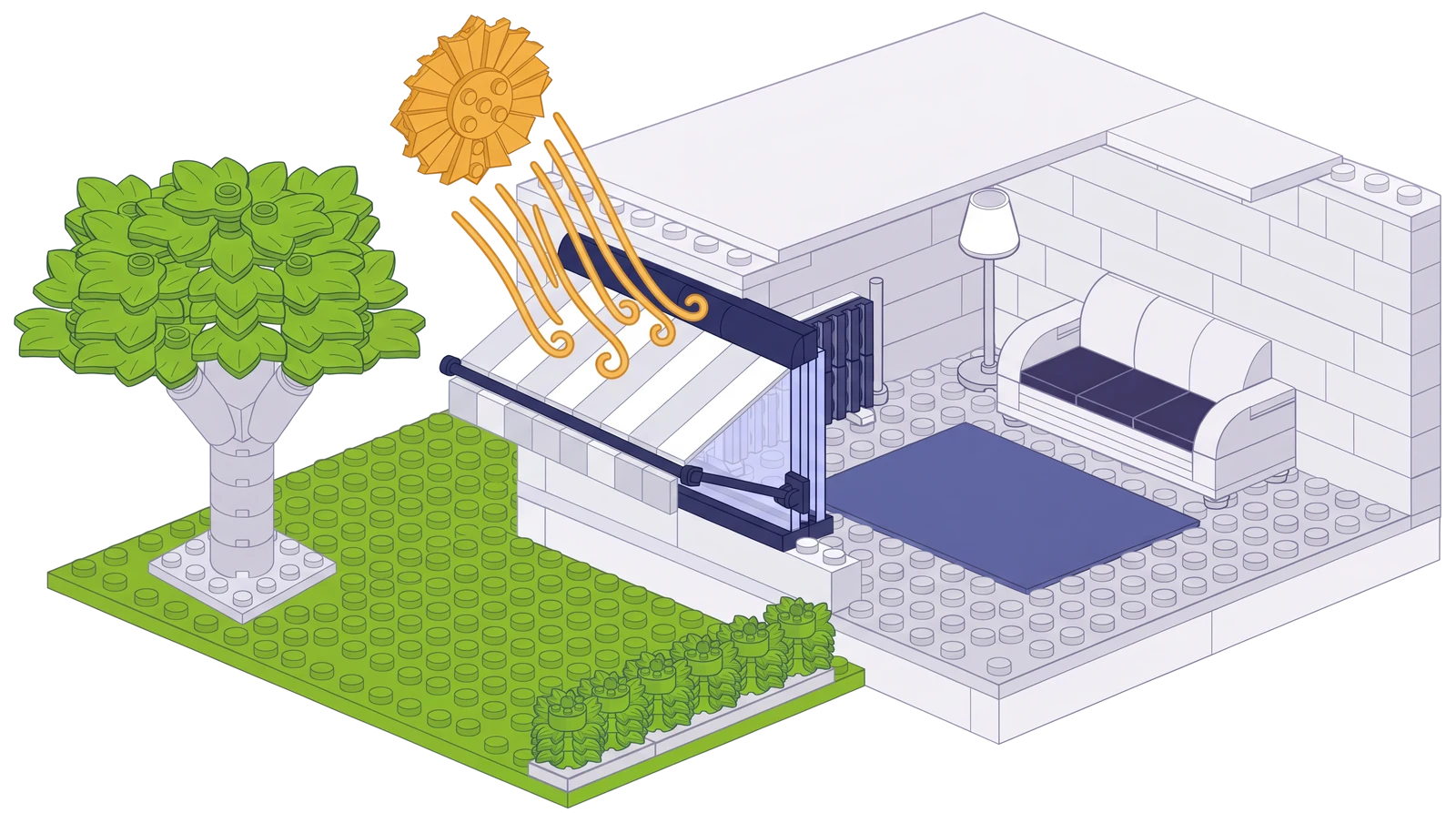
In your advice, this means: always ask for the g-value alongside the Ug-value, and look at the winter balance façade by façade. On the south side, high-g glazing such as pane A pays off, with an awning above it. Also look beyond the glass itself. The insulation value of the complete window counts too. The Uw-value covers the glass, the frame and the spacers between the panes.
Sources
Wolfgang Feist, Passivhaus Institut. Wärmeschutz und Behaglichkeit bei Fenstern. The rule of thumb Ug − 1.6 × g < 0 and the factor 1.6 for solar gain over the heating season. passivehouse.com (opens in a new tab)
NEN-EN 410:2011 (the Dutch adoption of EN 410). Glass in building, determination of luminous and solar characteristics of glazing. The measurement method for the g-value, at normal incidence. Not freely available; it can be consulted through NEN (the Dutch standardization institute).